
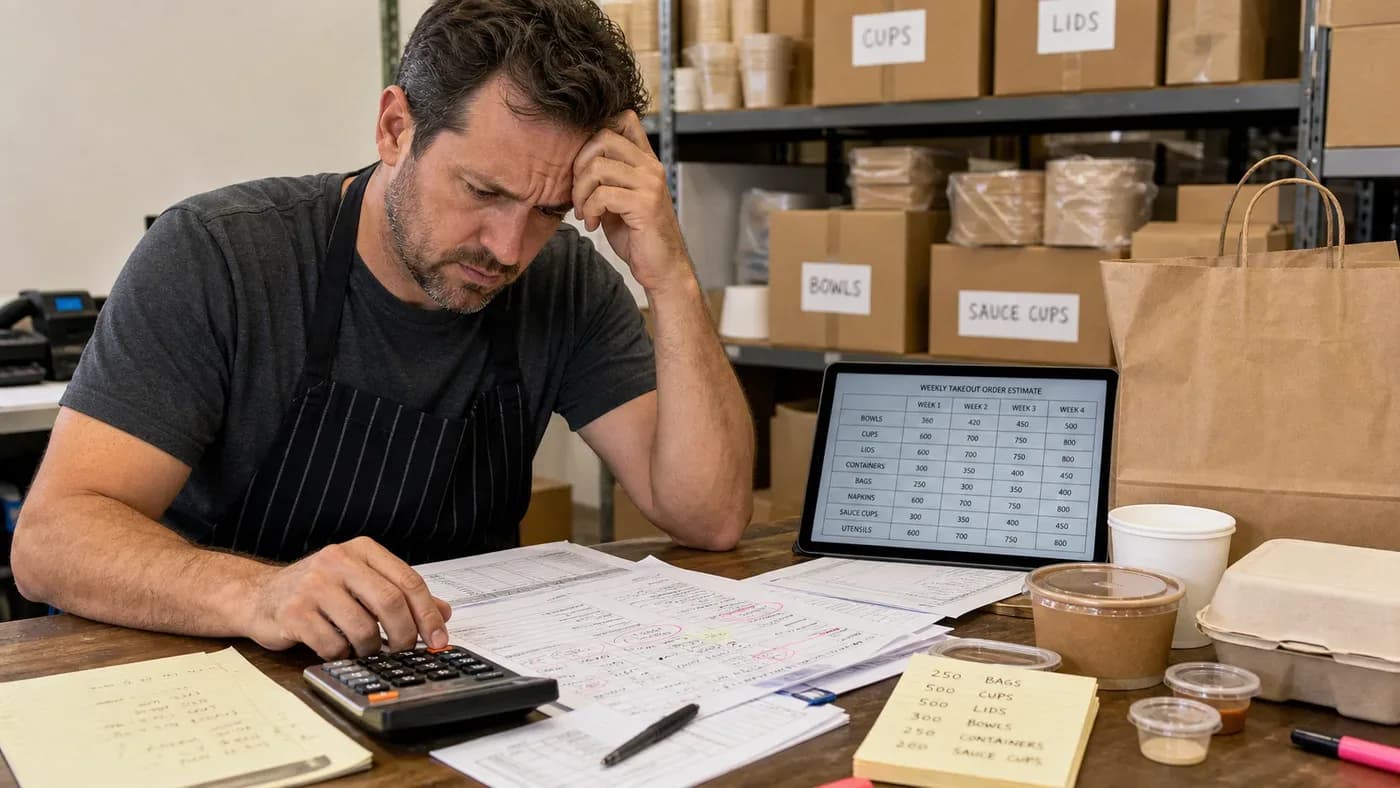
Start with units per order
A packaging forecast begins with the number of packaging units used per customer order. One online order might use one entree container, one side cup, one bag, one label, one fork, and two napkins. Another order might use two PET cups, two lids, two straws, one carrier, and one handle bag.
Do not use a single average for everything. Break the menu into item groups: entrees, bowls, fried foods, salads, desserts, cold drinks, hot drinks, sauces, combo meals, and catering. Then estimate how many packaging units each group consumes.
Use a practical first-order formula
For each packaging item, estimate expected daily use. Then calculate: daily use x days until next reliable reorder + safety stock. Round the result up to full case packs. If you expect 80 cold drinks per day, and reorder lead time is 10 days, you need at least 800 cups before safety stock and case-pack rounding.
For opening month, add a buffer for training waste, soft-opening traffic, lid mistakes, dropped cups, staff meals, unexpected menu mix, and sample testing. A 20-30 percent buffer is often more useful than a perfect-looking forecast that cannot survive opening reality.
Separate fast movers from slow movers
Fast movers are the packaging items used every day: main containers, most common cup sizes, matching lids, handle bags, labels, napkins, and utensils. These deserve strong opening stock and clear reorder points.
Slow movers are specialty trays, unusual cup sizes, seasonal printed items, catering-only pieces, or packaging for a menu item that may not sell often. Keep these lean until real sales data proves demand. Overbuying slow movers ties up cash and storage during a period when the restaurant needs flexibility.
Set par levels and reorder points
A par level is the target amount you want on hand. A reorder point is the level that triggers a new order. For packaging, a simple reorder point can be calculated as average daily use x supplier lead time, plus safety stock.
Example: if you use 120 PET cups per day, the supplier lead time is 12 days, and you want 300 cups of safety stock, the reorder point is 1,740 cups. Because cups come in cases, you would round to the next case quantity and check whether storage can hold that amount.
Plan by case pack and storage reality
Packaging is usually bought by case, not by exact unit count. A forecast that says you need 1,740 cups still becomes a case-pack decision. If the case pack is 1,000, you may order two cases and set a reorder trigger before the second case gets too low.
Storage matters as much as math. Bulky handle bags, carriers, catering trays, and cups can fill a back room quickly. A new restaurant should choose a stock level it can operate, count, and rotate without blocking prep space.
Track actual usage from the first week
The first order is an educated estimate. The second order should be based on real usage. Count how many cases were opened, which sizes moved fastest, which items were wasted in training, and which accessories were forgotten or overused.
Create a simple usage sheet by category: containers, bowls, PET cups, hot cups, lids, bags, carriers, labels, seals, sauce cups, utensils, napkins, and straws. After two to four weeks, adjust par levels to match the real menu mix.
How GreenPack Life can quote first orders
GreenPack Life can help translate daily order estimates into a first packaging quote. Useful inputs include expected daily orders, top menu items, drink sizes, delivery percentage, storage limits, opening date, and destination ZIP code.
For new restaurants, the goal is not to force the biggest possible opening order. The goal is to protect opening service, avoid wrong-fit items, and create a reorder rhythm that keeps packaging available without burying the operator in unused cases.